



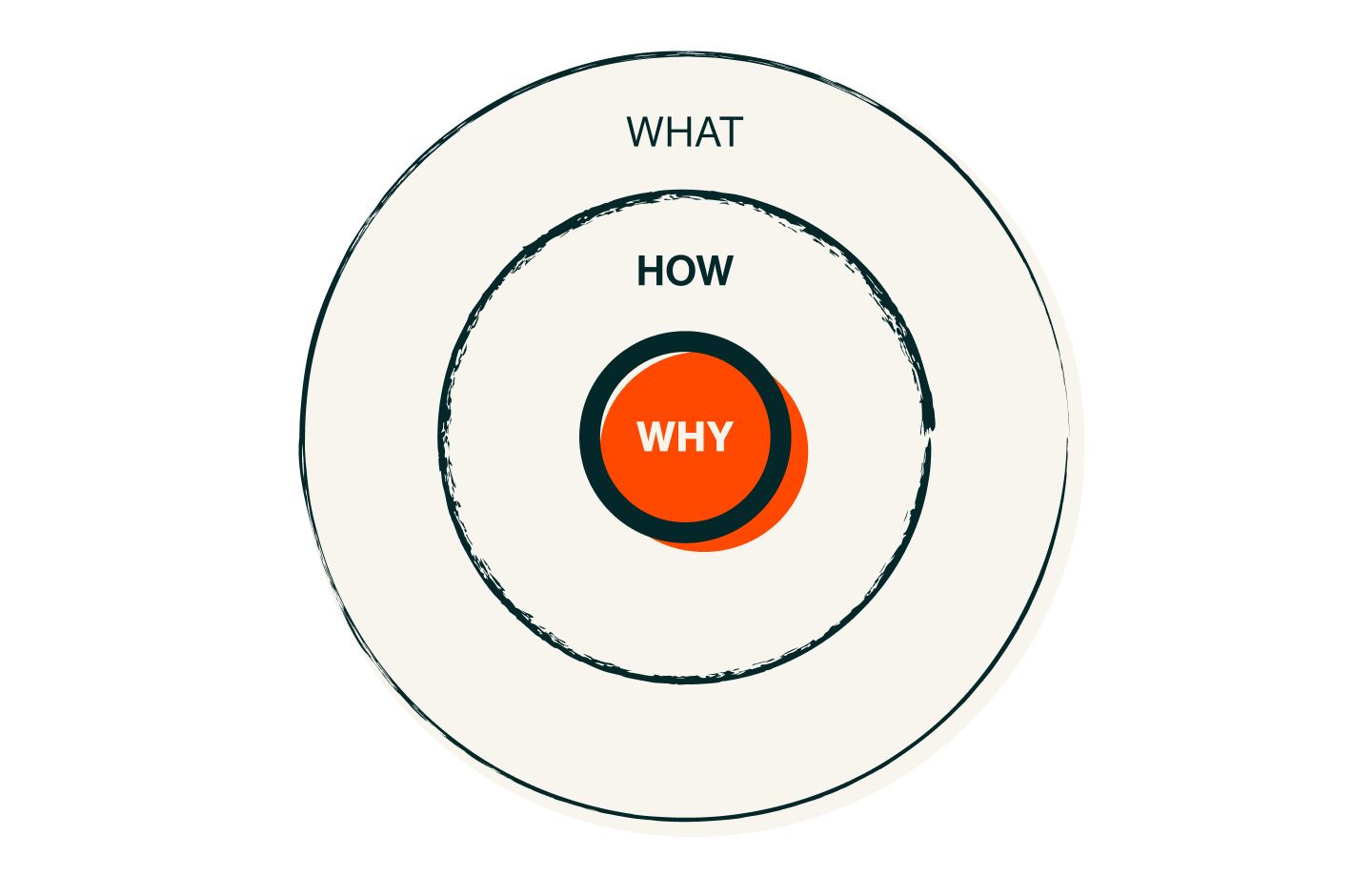
There is one video everyone should watch at least once in their life: The Golden Circle by Simon Sinek. Its core idea is as simple as it is powerful: people do not buy what you do (What), they buy why you do it (Why). For years, we focused on optimising processes (How) and perfecting the final product (What). Today, though, things are changing — and fast.
🔎 Caption
Why = why you exist, your cause.
How = how you accomplish that why in a unique way.
What = what you concretely offer (products, services, activities).
The fall of the circles
The "How" was the first to fall into the hands of LLMs. AI has democratised the ability to create. Everything related to execution has become a matter of minutes. In this new dimension, human talent can no longer compete with computational speed, algorithmic precision, and machines that never grow tired. The price of this speed is what Walter Benjamin described as the loss of the aura in The Work of Art in the Age of Mechanical Reproduction. By automating the process, AI removes action from the realm of tradition and uniqueness; in place of a singular creative act, it produces a flawless yet serial “quantitative series of events”. Execution is no longer a human ritual, but a technical function that drains the act of making of its value.
And if execution has already fallen, the final product — the service, the commercial offer — is beginning to waver too. The What has become a commodity: products and services, the very “what” a brand offers, can now be replicated by AI, which can reproduce business models, generate offers, and clone products in a matter of moments.
We are living in an age of aesthetically flawless content with no grip, of functional yet sterile products. AI is the realm of the “without”: without error, without effort, and unfortunately, without soul.
Keep calm and hold on to your Why
While AI now dominates the How and increasingly the What, the Why remains — for now — still ours.
AI has no purpose, only an optimisation target; it has no vision, only pattern recursion. If the algorithm is the master of the answer, the human being remains the only true guardian of the question. Human beings alone can infuse a brand with a deeper sense of purpose. This is why, to quote Simon Sinek, when consumers choose to buy an Apple iPhone, they are not simply buying “a well-made phone”, but a way of expressing innovation, creativity, and design.
The Why has always been what sets successful brands apart. In the months ahead — perhaps in the years ahead — the depth of that purpose may become the dividing line between those who move forward and those who fall behind.
Ander Group's WHY
We exist because, as long as companies continue to be held back by complex, cumbersome processes weighed down by bureaucracy and capable only of draining the enthusiasm of the people expected to use them, there will be a need for someone to rethink them from the ground up. Our Why is a challenge to the status quo: breaking free from bad organisational habits and outdated processes that slow down growth.
That is why we chose HubSpot. A platform built around simplicity and fluidity as guiding principles, proving that technology can be powerful while also being intuitive, accessible, and usable across every level of the organisation.
We believe in beautiful processes: processes that are not only efficient, but also able to engage people. When a process is clear, smooth, and harmonious, people step back into a central role, and the chances increase that they will abandon old habits and embrace technological progress.